Saturday, January 18, 2014

Lampshade tutorial

You can easily transform a lampshade by recovering with fabric of your choice. If you don't have one already, they can be picked up really cheaply at junk shops or yard sales. 

First of all, gather everything that you need:-


  • plain lampshade
  • fabric
  • large piece of paper ( a length of wallpaper is ideal)
  • scissors
  • pencil
  • straight edge
  • spray fabric glue (repositionable)
  • glue gun
  • cutting mat and cutter ( optional) 


1. Trace the lampshade onto the paper to create a template. Take time to do this accurately following the line slowly top and bottom and marking the start and finish point.


2. Join the edges with a ruler. Add 1cm to one of the vertical edge. This will create a neat finish where the edges join.


Add 1cm to top and bottom edges.


3. Cut out the template and then trace around it onto the wrong side of your fabric. If you are using a patterned fabric, be sure to position the template along the grain of the fabric. If you are using fabric with a motif or embroidery like mine, make sure it is central. Cut out the fabric.
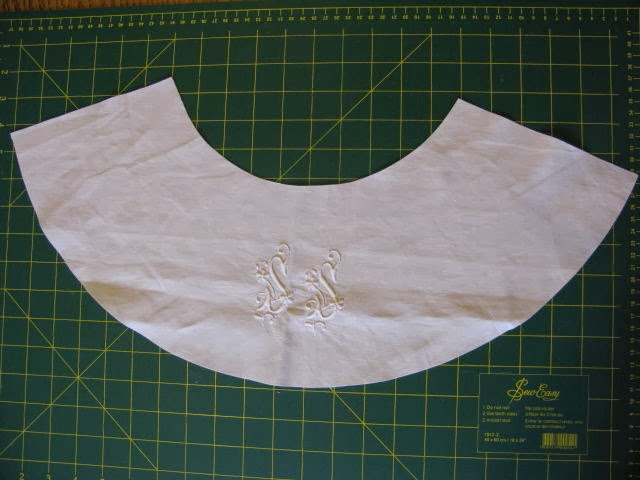


 4. Spray the wrong side of the fabric with a thin layer of glue. Do this in a well ventilated area. Turn down the vertical edge with the 1cm allowance and glue in place.


5. Starting at the raw vertical edge, carefully roll the shade along the fabric, lining up the edges as you go. Most small creases can be smoothed out but you may need to peel it back from time to time to ensure it lays flat. The folded seam should neatly cover the raw edge where they meet.


6. When you are happy with the finish, tuck under the overlapping fabric at top and bottom. You may need a little glue from a glue gun at this stage to ensure it sticks firmly.


7. That's it. Sit back and enjoy your handiwork!


Friday, January 10, 2014

Wood Art


From October onwards our French neighbour busies himself from dawn to dusk moving, cutting and meticulously stacking his woodpile. Trailor loads of metre long logs are trundled down to the designated area and arranged in a geometric style that would please any maths teacher.

For several weeks the ritual continues until at least a year's worth of logs have been accumulated and stacked. The end is result is very impressive. In France, wood is measured in 'stères' or cubic metres and even a modest house can burn several stères a year, hence the need to constantly replenish stocks and make sure wood is seasoned.


Woodpiles are something of an obsession in rural France. As much part of French life as growing and preserving produce. 


Does size matter? Apparently so. The bigger and longer the better! A woodpile it seems is a symbol of masculinity. Hunter-gatherer at it's most basic level. 


We haven't needed much wood this year. So far the winter has been mild. I'll go and touch wood!


Monday, February 11, 2013

French Comfort Food

When the temperature plummets we all need to dig a little deeper into our repertoire of comfort food recipes.
Offering up some one pot stop dishes like stew and shepherd's pie keeps us refuelled whilst we await the return of some warmer weather.
We tend to associate French cuisine with frills and fancy presentation, but its backbone is good quality local produce cooked simply.
Tartiflette is a classic winter dish from the Haute-Savoie region ( near the Alps) that uses basic ingredients which are easily transformed into a culinary hot water bottle. Here is the basic recipe but you can adapt it to your taste by adding stock instead of wine or leaving out the lardons for a vegetarian option.
Reblochon is a  round flattish cheese with a washed rind that is sold whole or in semi circular halves. It is not a cheese that will win any beauty contests but it's flavour is nutty and the texture inside is deliciously creamy.
If you can't get hold of Reblochon you can use a similar melting cheese.

Tartiflette


Serves 2 very hungry people with a little leftover for the next day or 4 normal appetites


1 kg firm potatoes

250g lardons or diced smoked bacon
2 medium onions
Half a Reblochon cheese
3 tablespoons crème fraiche
1 glass dry white wine

1. Peel and boil the potatoes until cooked. Leave to cool.

2. Preheat oven to 220 C.
3. Slice the onions thinly and fry with the lardons on a medium heat for a few minutes until the onion is golden and the lardons browned. There should be enough fat in the lardons but if the bacon is very lean you can add a little oil. Set aside to cool a little.


4. Slice the potatoes when cool enough to handle.

5. Butter a gratin dish. I use a dish 28cm by 20cm but anything similar will do.


6. Start to build the tartiflette in layers: potato, onion mixture, potato, onion and a final layer of potato. Resist the temptation to be neat here. Season in between the layers with salt and pepper ( or get someone else to as you'll be covered in sticky potato!). Dollop over the crème fraiche and spread over the top - no need to be fancy. Throw over the best part of a glass of wine. You can leave the wine out but it does add a layer of warmth to the dish. Just use whatever you have to hand. 
7. Slice the Reblochon through the equator and then into a few rough pieces and lay over the crème fraiche - some crust side up and some down. 


8. Into the oven for 30 - 40 minutes. 30 if the potatoes were still quite warm or 40 if the dish has been assembled cold or earlier in the day. Tartiflette is very forgiving and can be cooked and reheated or left in the fridge until ready to cook.


9. If you feel it is too much of a guilty pleasure, serve with a green salad. Just add pyjamas!


Any leftovers can be picked over the next day. 


Monday, December 24, 2012

Candlepower


When it comes to candles I'm a bit of a purist.
Garish reds and greens are not for me, I prefer the neutral tones that will always harmonize with your scheme and will enhance the candle holder rather than clash with it. 


Perfumed candles on the other hand are a different matter entirely. Clarets and deep forest greens and burnt oranges when combined with woody scents can be very comforting and bring a festive even pampering feel.


If the chores are done and you have a little time on your hands today, knock up some simple table decorations. Rope the kids in to find scraps of fabric and ribbon and using an ordinary jam jar you can create a pretty candle holder in minutes. I like to use some foliage - wood herbs like bay and rosemary work well but for a more traditional look use holly or ivy.
Pop in a stubby candle and voila! Simples.


Tealights can be used in small saucers and dessert dishes. I poked around our cupboards and found this cute little antique custard cup. Glass works particularly well so if you have old bottles or jars think about upcycling them. 


A very Merry Christmas to all of you 

Monday, November 12, 2012

The Joy of Jouy


On my travels this weekend I discovered the most wonderful piece of antique Toile du Jouy.
Although much of it had been munched away by moths, enough of it remained to get me thinking about a new cushion project. The story of the Toile du Jouy began way back in 1760...

This well known style of fabric was developed by Christophe-Philippe Oberkampf in a town near Versailles called Jouy-en-Josas. He employed talented designers such as Huet to portray romantic figures in pastoral and often political scenes. Such was the quality of Oberkampfs prints that Napolean visited the factory and requested he bring some of his finest fabrics as gifts for ladies of the court. The prints became very popular and the style was adopted by many other factories during the early 19th Century although none truly matched the designs that were produced at Jouy.

It is the fine detail on the engraving of this piece that gives it such charm and sets it apart from the modern reproductions. It was probably a coverlet or curtain originally and dates from around 1835.


Friday, August 31, 2012

In a pickle

So, it's that time of year when the veggies are a plenty. Too plentiful to be honest, if there is such a thing. All my feeding, pinching out and nurturing has paid off and now I am faced with a daily basketful of red and yellow marbles. Well cherry tomatoes actually. They are at their best in a salad, or just popped in the mouth whilst being harvested, but when it comes to preserving them, there is a dilemma. To roast, to freeze, to bottle, to...? Well, what about to pickle? Or to jam to be precise as tomato is a fruit after all.


Jamming the little red poppets provides the perfect solution to the glut. There is not enough flesh to pad out the waiting jars and I can't be doing with faffing about drying them so I have found a recipe that can be adapted depending on what else is available and this solves the problem. The bonus is that they don't have to be skinned which was also presenting various time consuming issues. Whack a bit of chilli in and you have something that will spice up a cheese sarnie or is a perfect accompaniment to a curry. Great with sausages and burgers too.


This is what I did to them...


Cherry Tomato Jam


Ingredients

  1. 2 tsp cumin seeds
  2. 2 tsp coriander seeds
  3. 750g ripe cherry tomatoes, halved
  4. 2 onions, finely chopped, (apples and courgettes optional)
  5. 2 fat garlic cloves, crushed
  6. 5cm piece fresh ginger, grated
  7. 250ml white wine vinegar
  8. 300g soft light brown sugar
  9. 2 tsp soy sauce
  10. 2 large mild red chillies, deseeded and finely chopped ( optional)

Method

  1. 1. Put the cumin and coriander seeds in a small frying pan and toast over a low heat for 1 minute, then crush in a pestle and mortar.
  2. 2. Put the tomatoes and onions (a couple of windfall chopped apples or courgettes can be added at this stage) in a wide pan with the garlic, chillies and ginger. Add the spices, vinegar and sugar. Bring to the boil, then simmer until reduced to a jam-like consistency - can take 3 -4 hours. Add the fish sauce and cook for 2 more minutes before spooning into sterilised jars.
  3. 3. Seal the jars while hot, then allow to cool completely before labelling and storing.

Tuesday, August 28, 2012

Wacky Races

         Close ups at Angouleme


The Circuit Des Remparts in Angoulême is one of only 2 street races in Europe ( the other being Monaco) and every September brings racing enthusiasts flocking to this part of South West France.

Commonly known as 'Monaco without the sea', the race offers spectators the chance to see, Bugattis, Rileys, Fraser Nash and MGs as well as post war Porches and TVRs.
The event has been running every 3rd weekend in September since 1939 with only a break during the war years and is a unique spectacle worth a visit simply for the atmosphere.